Meteor Dodge: Making the Same Idea Feel Different
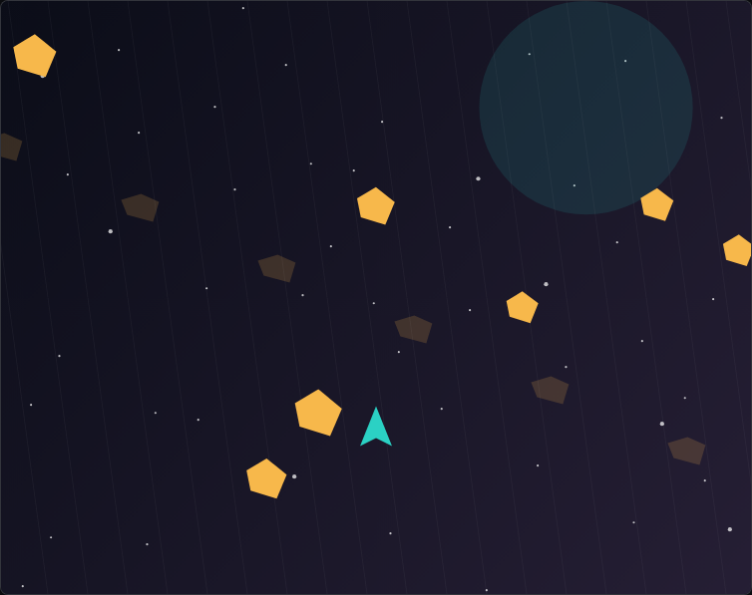
Dodge-the-falling-rocks is one of the oldest game mechanics in existence. I know this. I built Meteor Dodge anyway, partly as a technical warmup and partly because I had a theory: the reason most dodge games feel samey is that they treat the player as passive. You move away from things. I wanted to see if I could make the player feel like an active presence in the space, not just a hitbox getting out of the way.
Giving the Ship a Personality
The first change I made that actually mattered was adding momentum to ship movement. In most dodge games the ship teleports to wherever the mouse is, pixel-perfect. It works but it feels like operating a cursor, not flying a ship. I added a velocity system — the ship accelerates toward the cursor position and decelerates smoothly when the cursor stops. The responsiveness is tuned so it never feels sluggish, but there's a tiny tail of inertia that makes the ship feel like it has mass. Players immediately started calling it "the ship" rather than "the thing." Subtle personification through physics. I also added a subtle tilt on horizontal movement — the ship banks slightly when moving left or right and levels out when stopped. One CSS transform, three lines of code, massive difference in how it reads as a flying vehicle versus a rectangle.
Meteor Variety and Why Size Alone Isn't Enough
My first build had meteors in three sizes: small, medium, large. That's it. The problem was that size was also speed — small meteors moved fast, large ones were slow — so the whole game reduced to "dodge fast things" vs "dodge slow things." It wasn't interesting. I broke the correlation between size and speed. Large meteors can now fall fast if the difficulty warrants it. Small meteors can drift slowly at a wide angle, cutting across the screen like a slow curve ball. I also added a "cluster" meteor type that splits into three smaller pieces when it crosses 60% of the screen height — visible foreshadowing in the first half, chaos in the second. Players now have to read trajectory, size, speed, and type simultaneously, which is actually a meaningful skill to develop over multiple sessions.
Screen Shake, Streaks, and the Near-Miss
The moment I'm proudest of in Meteor Dodge is the near-miss feedback. When a meteor passes within 20 pixels of the ship without hitting, the game registers it as a "near miss" — the screen flashes a very brief teal tint, the ship gets a momentary thrust-exhaust trail, and a small "+near" indicator fades in above the ship. Nothing changes mechanically. No bonus points, no power-ups. But acknowledging the near-miss transforms it from a neutral event into a moment of triumph. Players start to seek them out. They'll cut a dodge closer than necessary because threading between meteors feels more exciting than comfortable evasion. That one feature changed how people talk about the game — they started sharing moments, not just scores. Near-misses became the thing Meteor Dodge is actually about.
Browse All Games