Pendulum Hit: When the Entire Game Is a Single Moment
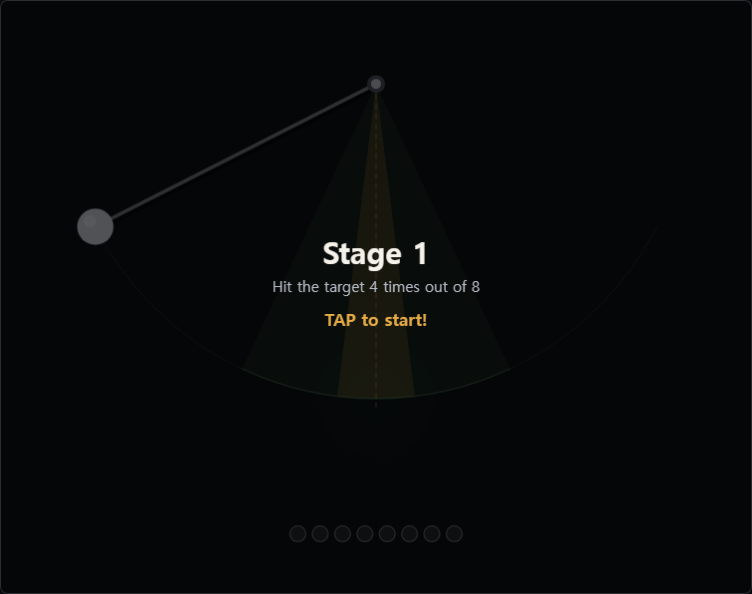
Pendulum Hit might be the smallest game I've ever built in terms of interactions — you watch, you wait, you tap once. That's the entire game. But designing something with that level of constraint turned out to be one of the most challenging and rewarding experiences I've had building browser games. There's nowhere to hide when everything hinges on a single moment.
The Physics of Anticipation
A pendulum follows a sinusoidal arc — it accelerates toward the bottom of its swing and decelerates at the extremes. I initially modeled this with a pure sine function, which was physically accurate but felt wrong to play. The problem: at the bottom of the swing, the bob moves fastest, which is exactly where the target zone sits on lower stages. Players felt cheated even when they tapped correctly, because the window was too narrow at speed. I added a subtle ease-out near the target center — not enough to break the physics illusion, but enough to give players about 40ms more grace at the sweet spot. That 40ms changed the hit-rate from frustrating to fair. I also animated a faint motion arc trailing behind the bob, which gives your eye a subconscious read on velocity before the target zone arrives.
Scaling Difficulty Across 10 Stages
My first instinct was to simply increase pendulum speed at each stage, but playtest feedback was blunt: stages 6 through 10 felt impossible while stages 1 through 4 felt pointless. The speed increase was too steep. I rebuilt the difficulty curve around three variables: swing speed, target zone width, and target zone position. Early stages use a centered, generous target and a slow pendulum. Mid stages shrink the target zone and shift it slightly off-center, so players can't just mash at the midpoint. Late stages combine a narrow target, high speed, and an off-center position that forces players to develop a genuine sense of pendulum timing rather than relying on rough approximation. Each stage only changes one variable noticeably — the others shift subtly — so the difficulty feels like a gradient rather than a wall.
Making a Miss Feel Meaningful
When your game is one tap, a miss has to communicate something. My first version played a short error sound and reset. Players felt nothing — no information, no connection to what went wrong. I redesigned the miss state entirely. When you tap outside the zone, the bob flashes red and a small arc highlights exactly where your tap landed relative to the target. An "early" or "late" label appears briefly so players understand whether to adjust their timing forward or back. The pendulum doesn't reset immediately — it completes its current arc so you can watch where your tap fell in context. This extra second of information transformed miss reactions from frustration to calibration. Players stopped blaming the game and started analyzing themselves. That shift in mindset is what keeps people playing through all ten stages.
Browse All Games