Tap Sprint: Making Speed Feel Physical in a Browser Game
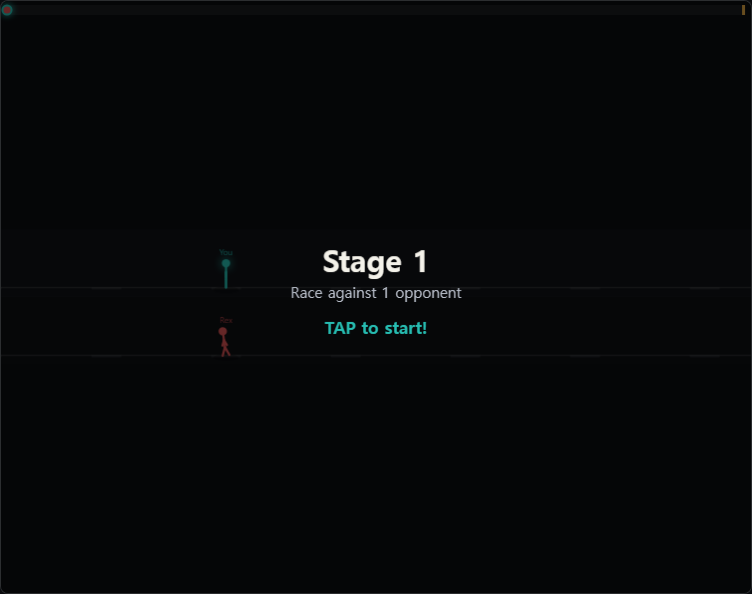
I started Tap Sprint with one question: can a browser game make tapping your finger feel like real physical effort? Tapping is abstract. It has no inherent connection to running or speed. My job was to build that illusion — and it turned out to be a much more interesting design problem than I expected.
Translating Taps Into Motion
The core mechanic sounds deceptively simple: tap faster, run faster. But raw tap count per second creates two problems. First, experienced players can tap at 12–14 taps per second and completely dominate from stage one. Second, casual players feel like they're furiously hammering with no reward because the movement looks incremental. My solution was a velocity model with momentum decay. Each tap adds a burst of speed, but that speed decays continuously between taps. This means consistent rhythm matters more than brute speed — there's a sweet spot cadence for each stage. Stage one allows generous decay so newcomers feel fast immediately. By stage ten the decay rate has tightened to the point where even a half-second lapse in tapping costs you first place. That decay curve did more for game feel than anything else I tried.
Building Ten Opponents That Feel Alive
Ten AI opponents on screen at once is a lot of moving parts. My first implementation used simple linear velocity with a small random offset per bot — and it looked like a parade, not a race. Every bot moved in lockstep with minor jitter. I scrapped that and built a fatigue model. Each opponent has a stamina pool that depletes as they sprint. When it dips below a threshold they slow slightly, then recover. The timing of these mini-fatigue cycles varies per opponent and per stage, so the field genuinely spreads and bunches over the course of a race. One opponent might pull ahead dramatically on the first half of stage three only to fade and let the player catch them. That dynamic tension — watching an opponent falter just as you're about to fall behind — is what makes the race feel real rather than scripted.
The Feedback Loop That Makes It Addictive
Speed alone isn't satisfying. I needed the player to feel their effort in something beyond watching their character move forward. I added three layers of feedback that all activate on tap. The character's stride animation speeds up proportionally to current velocity, so fast tapping triggers noticeably bigger, choppier leg movements. The background parallax — a simple two-layer horizontal scroll — accelerates with a slight lag, giving a sense of physical inertia. And the tap button itself squishes briefly on each press: a 60ms scale-down followed by a spring-back easing. Individually each of these seems minor. Together they create the sense that your thumbs are genuinely powering the runner forward. Several playtesters described tapping as "tiring" — in the best possible way. When your interface makes people feel physical exertion, you've done something right.
Browse All Games