Pendulum Hit: Designing a Game Around a Single Arc
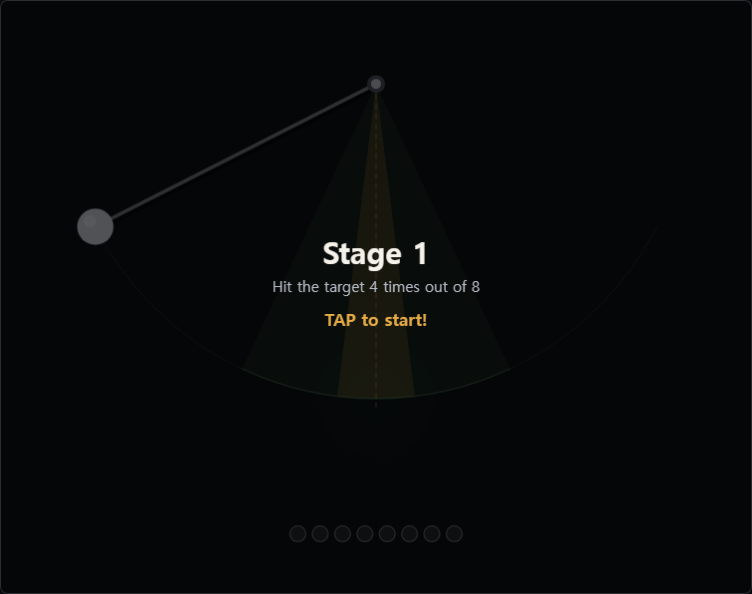
Pendulum Hit has exactly one mechanic: a pendulum swings, and you tap when it aligns with the target. That is the complete game description. There is no second mechanic waiting to unlock, no resource to manage, no spatial navigation. Every design decision had to serve that single moment — and because there was only one moment, every variable in it mattered disproportionately.
What the pendulum arc communicates
A pendulum does not move at constant speed. It accelerates through the middle and slows at the extremes. This is immediately legible to players — most people have an intuitive sense of how pendulums behave — but it creates a subtle design problem. The target sits at the center of the arc, which is also where the pendulum is moving fastest. You have less time to react at the moment you need to act most precisely.
Early testing showed players consistently tapping slightly late. They were timing their reaction from the moment the pendulum appeared to be heading toward the target, but the acceleration meant it arrived sooner than they expected. The solution was to compress the target window slightly toward the leading edge — the pendulum registers a hit just before perfect center as well as at perfect center. Players do not consciously notice this correction, but their timing feels more accurate because the game is meeting them where their instincts lead them.
How the difficulty curve narrows
Pendulum Hit runs for ten stages. Each stage increases both the pendulum speed and decreases the target width. The challenge is calibrating these two changes so they compound correctly. If speed increases faster than target size shrinks, the late stages feel like a different game — pure reaction test with no room for timing skill. If target size shrinks faster, early stages feel trivially wide and late stages feel impossibly narrow.
The tested ratio that worked: speed increases by about 12% per stage, and target width decreases by about 8% per stage. This keeps the effective window — the time during which a hit registers — shrinking at a consistent pace, while the increasing speed means you have less absolute time to make the decision. At stage ten, the window is narrow enough that a hesitation of more than a single frame costs the hit. Players describe this as pressure rather than unfairness, which is the right feeling for a game that asks for precision.
The role of the miss animation
One overlooked design detail is what happens when you miss. A bad miss animation destroys the rhythm of the game — you wait for it to finish, your concentration resets, and the next attempt feels like a fresh start rather than a continuation. Pendulum Hit's miss response is deliberately brief: a short color flash, a half-second pause, and the pendulum is already swinging again. The feedback is clear enough to register but short enough to keep the player in the zone. Getting that timing right took almost as many iterations as the difficulty curve.
Play Pendulum Hit