Lane Rush: The Design Challenge of Infinite Difficulty
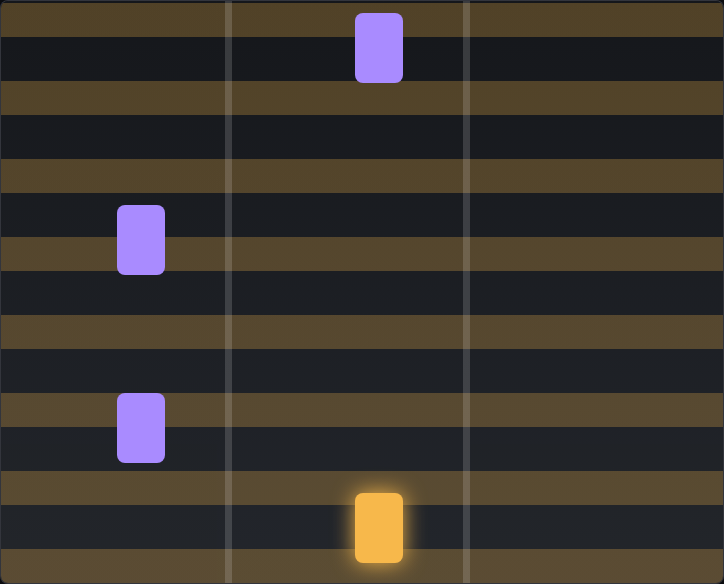
The earlier post on Lane Rush explained why three lanes is the right number for a game like this. This one is about what happens inside those three lanes — specifically, how to keep the difficulty climbing for a player who might reach any score before they stop playing.
The flat ceiling problem
Most lane games hit a wall. Obstacle speed increases linearly until it reaches some maximum, and after that the game feels identical no matter how long you play. Players describe this as "the game stopped getting harder." What they mean is it stopped feeling harder — the actual challenge plateaued, so the sense of progress disappeared with it.
Lane Rush addresses this with two separate escalation tracks. The first is speed: the world scrolls slightly faster with each passing second, with the rate of increase slowing gradually so the jump from 30 to 60 seconds feels similar in effort to the jump from 60 to 120. The second is obstacle density: the algorithm spawns clusters more frequently and leaves shorter recovery windows. These two tracks compound. At high scores, the gap between surviving obstacles and generating them approaches zero — but they never quite meet, which means there's always theoretically a next second.
Designing for asymmetric pressure
One early problem was that obstacles tended to cluster in the same lane the player was already in. This felt unfair — not because the game was breaking rules, but because it was breaking the expectation that switching lanes would help. Players who switched away from danger were finding danger waiting for them on the other side.
The fix was an asymmetric cooldown per lane. After generating an obstacle in a lane, that lane is suppressed from spawning again for a short window proportional to the current obstacle density. High-density phases suppress longer. This creates implicit breathing room: there is almost always at least one lane with a short clear window ahead, and the better a player gets at reading that window, the longer they survive.
Reading the pattern before it's visible
Advanced Lane Rush players describe something that feels almost like prediction: they start moving before the obstacle is fully visible. What they're actually doing is reading the spawn bias. Because the cooldown system suppresses recently used lanes, patterns emerge. A player who just moved left to avoid an obstacle in the center has a few frames of information: the center lane is temporarily cleared, and the right lane hasn't been used in a while. That is enough to start committing to the next move before the next obstacle spawns.
This wasn't designed explicitly. It emerged from the cooldown system and only became visible in playtesting when high-skill players started scoring dramatically better than mechanical reaction time would predict. Discovering it made me realize that even a minimal game loop can reward the kind of pattern recognition that separates experienced players from new ones — without any visible complexity for beginners to be intimidated by.
Play Lane Rush